









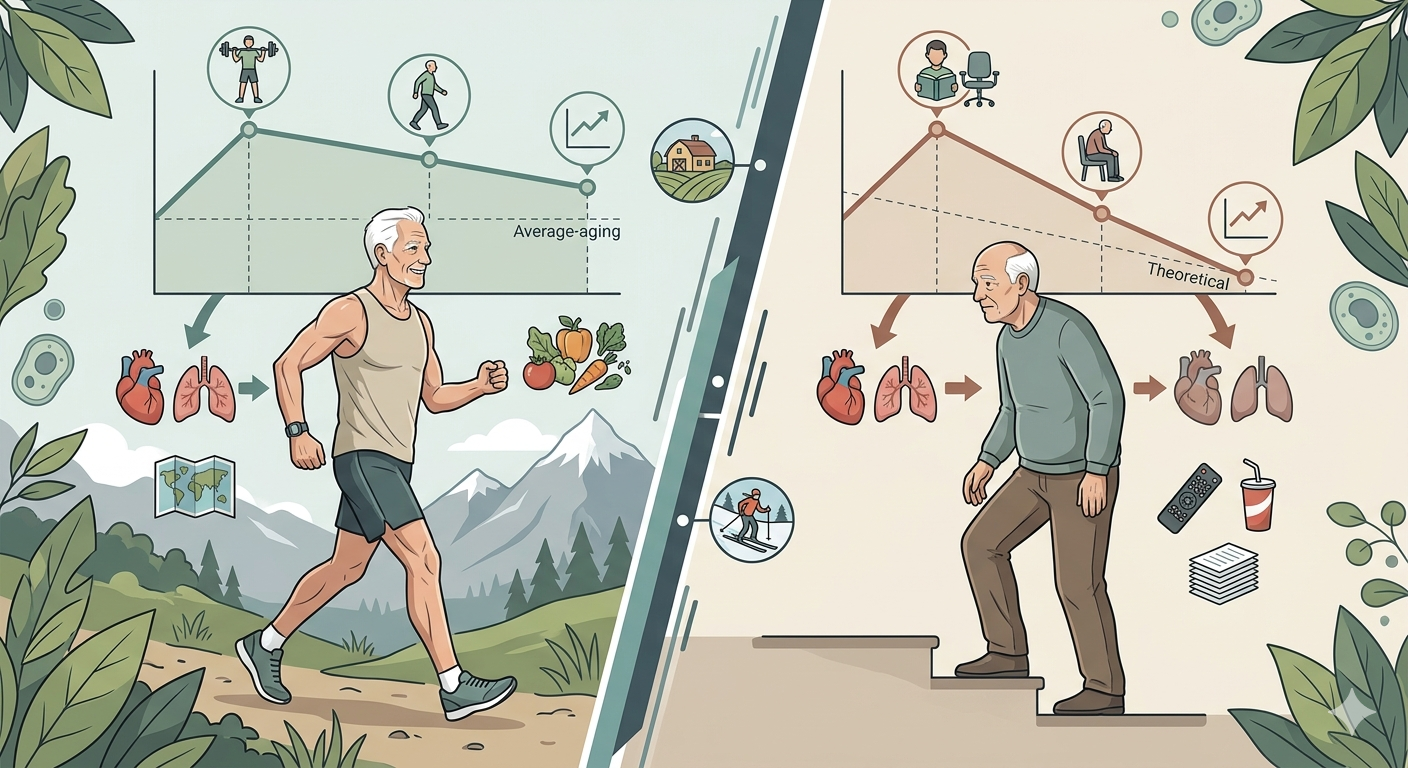
Most people assume that getting old means getting weak, getting slower, and gradually losing the ability to do the things they once could. The body declines. That part is true and unavoidable. But how fast it declines and where it ends up after decades of gradual loss is a very different question, and a 2015 study published in Case Reports in Medicine gave us one of the most striking answers to that question ever documented in a laboratory.
An 80-year-old Norwegian man walked into a research facility and tested with the cardiovascular fitness of a healthy active 35-year-old. Not good for his age. Just good. His heart, lungs, blood, and muscles were functioning at levels that researchers confirmed may represent a world record for anyone his age on the planet. And the explanation for how he got there is not complicated. It is just inconvenient for most of us to hear.
What Is Cardiovascular Fitness and Why Does It Predict How Long You Live
Before getting into the man himself, it helps to understand what cardiovascular fitness actually means and why it matters so much more than most people realise.
Your body needs oxygen to produce energy. Every cell, every organ, every muscle runs on it. When you exercise, your muscles demand more oxygen, and your heart, lungs, and blood all have to work harder to deliver it. The maximum amount of oxygen your body can consume and use per minute during all-out effort is called VO2max. Think of it as the size of your engine. A bigger engine means your heart pumps more blood per beat, your lungs exchange gases more efficiently, your blood carries more oxygen, and your muscles extract and use it better at the cellular level.
Why does this predict how long you live? Because a high VO2max means every one of those systems is working well simultaneously. When any part of the chain breaks down, the number drops. Research published in the New England Journal of Medicine found that cardiovascular fitness predicted mortality more powerfully than blood pressure, cholesterol, smoking, and diabetes combined. The fitter you are in this specific sense, the longer and healthier your life tends to be. It is not a perfect rule but it is one of the strongest signals in all of preventive medicine.
The average sedentary 80-year-old has a cardiovascular fitness level roughly equivalent to someone who can barely climb two flights of stairs without stopping. This man’s level was equivalent to a fit, active person in their mid-thirties.
The Man and His Numbers
He grew up on a small farm in a remote mountain region of northern Norway with no road access. His childhood was physical by necessity, farming, fishing, hunting, carrying things, building things. He never stopped moving throughout his adult life. By the time researchers assessed him in 2013 at age 80, he weighed 66.6 kilograms, had never smoked, and was on no medication except a low-dose aspirin.
His body was 49 percent muscle and only 12 percent fat. For reference, most men his age carry significantly more fat and far less muscle. His blood pressure, cholesterol, blood sugar, and kidney function were all entirely normal, not normal for an 80-year-old but simply normal by any standard.
His cardiovascular fitness score was 50 units, measured in a treadmill test that was independently confirmed twice in two separate laboratories to rule out any measurement error. The average inactive 25-year-old scores around 35 to 40. The average healthy active man in his mid-thirties scores around 50. This man, at 80, matched that exactly. Researchers noted it may be the highest cardiovascular fitness score ever recorded in someone his age anywhere in the world.
What Was Actually Happening Inside His Body
The research team did not just measure one number and call it a day. They examined every system that contributes to how well the body delivers and uses oxygen, and every single one came back younger than his age had any right to produce.
His heart was pumping at levels more typical of a man in his 40s or 50s. The chambers filled and emptied properly, the walls moved correctly, and the pressure inside the heart during exercise stayed where it should. He had a pacemaker fitted about ten years earlier because his heart had developed an irregular rhythm at rest. But the moment he started pedalling lightly on a bicycle in the laboratory, his heart immediately switched to a normal rhythm on its own. The system only revealed its true capability when it was asked to perform.
His lungs were functioning at 128 percent of what would be predicted for a man his age. More importantly, the efficiency with which his lungs transferred oxygen into his bloodstream was at 149 percent of the age-predicted value. His blood volume was 17 to 19 percent higher than reference values for older men, and his total haemoglobin, the molecule in red blood cells that carries oxygen, was at levels comparable to moderate performance endurance athletes. More haemoglobin means the blood can carry more oxygen per litre, which directly feeds into how much oxygen the muscles can receive and use.
None of these systems worked in isolation. The heart, lungs, blood, and muscle were all operating above expectations simultaneously, which is exactly why his overall fitness score was so far above what anyone his age normally achieves. You cannot have the fitness of a 35-year-old at 80 if one link in that chain has collapsed. Every link has to hold.
How He Actually Lived Every Day
The research team had him wear an activity tracker for six days, which he said was a completely normal week for him. He averaged nearly 11,000 steps per day. He spent almost three hours per day moving at a pace that counted as at least moderate physical activity. His daily movement was seven times the recommended amount of moderate activity and twice the recommended amount of vigorous activity. He was outwalking the average Norwegian man in his 20s and 30s by roughly 2,600 steps per day at the age of 80.
His formal exercise routine at the time was not extreme. About 30 minutes three times per week combining some endurance work with strength training. But the tracker revealed that formal sessions were only a small part of the story. His whole day was physically active. He walked constantly, moved constantly, and had done so his entire life. The activity was not scheduled around his life. It was his life.
He had also competed in ultraendurance cross-country ski races in his late 60s and early 70s, including the Vasaloppet, a 90-kilometre race, and the Birkebeiner, a 54-kilometre race, finishing near the top of his age group in both.
The Most Important Finding: What His Lifetime Trajectory Shows
Here is the part of the data that carries the biggest practical message. When he was 25, workplace health testing recorded his cardiovascular fitness at approximately 75 units. At 45, approximately 58 units. At 80, 50 units. So he declined, as everyone does. But the rate of decline was unusually slow, particularly from age 50 onward, where he lost only about 0.23 units per year compared to steeper rates seen in other studied populations.
The researchers make a point that is easy to miss but critically important. His fitness at 80 was extraordinary not only because he aged slowly but primarily because he started so high. He had built an enormous ceiling in his youth, and after 55 years of gradual decline, he still had more left than most people start with. The study states directly that the importance of having a high cardiovascular fitness level at a young age cannot be overstated. You cannot rebuild the ceiling in your 70s. You can only slow the descent from wherever the ceiling already is.
There was also a visible dip in his trajectory around the time he sustained a serious injury at age 42 and was inactive for a period. Decades later, that interruption was still traceable as a steeper decline between 25 and 45 compared to the slower rate he achieved from 45 to 80 when he remained consistently active. One significant period of stopping left a permanent mark in the data.
What This Means for Anyone Who Is Not 80 Yet
The takeaway is not that everyone can achieve what this man achieved. He had an unusually high starting point, a lifetime of habitual movement going back to a physically demanding childhood, and perhaps a genetic predisposition to retain cardiovascular function longer than most. He is an outlier by any measure.
But the principles his data demonstrates apply universally. Cardiovascular fitness is one of the most powerful predictors of how long you live and how well you function in the years you have. It is built slowly over years and lost gradually if the stimulus is removed. The higher the level you build and maintain during your 20s, 30s, 40s, and 50s, the higher your starting point is for the inevitable decline of later decades. Waiting until health anxiety sets in at 60 or 70 to take fitness seriously means working from a lower ceiling than you had access to earlier. The decline is unavoidable. The floor you land on is not.
The Bottom Line
An 80-year-old Norwegian man documented in a 2015 peer-reviewed case report had the cardiovascular fitness of a healthy active 35-year-old, clean blood markers across every metabolic measure, 49 percent of his body weight as muscle, and nearly three hours of daily physical activity as his completely normal routine. His result was not produced by a late-life intervention. It was the compounded output of movement treated as a default condition of daily life from childhood onward, never substantially interrupted, never outsourced to a scheduled block three times a week. The body you will have at 70 and 80 is being built or neglected right now. The evidence on that is about as clear as evidence gets.
Reference;
https://pmc.ncbi.nlm.nih.gov/articles/PMC4348610/