







If you have ever been told your blood pressure is creeping up, the first thing anyone says is cut the salt. Reduce sodium. Stop eating processed food. Read every label. Avoid the shaker at the table. And while that advice is not wrong, it is incomplete in a way that has real consequences for a lot of people. The half of the conversation that almost nobody is having is about potassium, and the evidence suggests that actively increasing your potassium intake may be just as important for blood pressure management, if not more so, than focusing exclusively on how much sodium you are removing. These are not competing strategies. But the consistent neglect of potassium in mainstream health conversations means most people are only pulling one lever when they could be pulling two.
What the Research Actually Shows
A WHO commissioned meta-analysis pulled together 22 randomized controlled trials covering 1,606 participants to examine what happens to blood pressure when potassium intake is deliberately increased. The headline finding was clear. In adults with high blood pressure, increasing potassium intake dropped systolic blood pressure by an average of 3.5 mmHg across all studies pooled together. In the subset of studies where potassium intake reached 90 to 120 millimoles per day, which translates to roughly 3,500 to 4,700 mg, the systolic drop reached 7.2 mmHg. Diastolic blood pressure followed a similar pattern, with pooled reductions of around 1.5 to 2 mmHg across the studies.
To put that in context, a reduction of 5 to 7 mmHg in systolic blood pressure is considered clinically meaningful and sits in the range that some antihypertensive medications produce at standard doses. This is not a trivial rounding error on a graph. For someone managing stage one hypertension, a dietary change that moves the needle by 7 mmHg is a significant intervention. There is an important caveat worth being honest about though. This blood pressure benefit was only statistically significant in people who already had hypertension. In adults with normal blood pressure at baseline, the effect did not reach significance. The meta-analysis also noted that no clean dose response relationship was formally established between the two effect sizes reported, meaning we have two data points rather than a smooth predictable curve showing that every incremental increase in potassium produces a proportional drop in blood pressure. The practical implication is that the evidence is strongest for people who are already hypertensive, and that is the population where the intervention is most clinically relevant anyway.
How Potassium Actually Lowers Blood Pressure
The mechanism is worth understanding in some detail because it reveals why potassium is not just a secondary consideration after sodium but something with its own independent pathway to blood pressure reduction. Potassium works through two simultaneous mechanisms, and the fact that both operate at the same time is part of why the effect size in trials is as meaningful as it is.
The first mechanism operates at the kidney level. Potassium inhibits a sodium reabsorption channel called the sodium chloride cotransporter, or NCC, located in the distal convoluted tubule of the kidney. When this channel is inhibited, less sodium gets reabsorbed back into the bloodstream and more is excreted in urine. In practical terms, eating more potassium causes your kidneys to actively clear more sodium from your body. This is why the sodium and potassium conversation cannot really be separated. They are physiologically intertwined at the level of the kidney, and managing one without thinking about the other gives you an incomplete picture.
The second mechanism operates directly at the level of your blood vessels. Potassium opens potassium channels in the smooth muscle cells lining the arterial wall. This causes the membrane potential of those cells to become more negative, a process called hyperpolarization, which reduces the likelihood that those cells will contract. When vascular smooth muscle relaxes, the artery dilates, resistance drops, and blood pressure falls. This is a direct vasodilatory effect that operates entirely independently of what is happening at the kidney. Two distinct mechanisms, one mineral, acting simultaneously. That combination is why the effect is real and measurable even in short duration trials.
The Intake Gap Most People Do Not Know About
Here is where the practical problem becomes concrete. The 2019 National Academies of Sciences, Engineering, and Medicine set adequate intake targets at 2,600 mg per day for women and 3,400 mg per day for men. These are not upper limits or therapeutic doses. They are the baseline adequate intake estimates for generally healthy adults living normal lives. NHANES dietary surveillance data puts the average US adult intake at approximately 2,300 mg per day. That means the typical adult is falling short of even the adequate intake threshold, not by a trivial margin, and not in a small subset of the population. This is a widespread and largely unaddressed shortfall in a mineral with measurable effects on one of the most prevalent chronic disease risk factors in modern medicine.
What makes this particularly striking is how little attention it receives relative to the sodium conversation. Sodium reduction is discussed constantly in clinical settings, public health campaigns, food labeling regulations, and fitness content. Potassium adequacy barely comes up. Yet the evidence base for potassium’s role in blood pressure management is substantial, the mechanisms are well understood, and the foods that provide it are not exotic, expensive, or difficult to access.
Closing the Gap Is Not Complicated
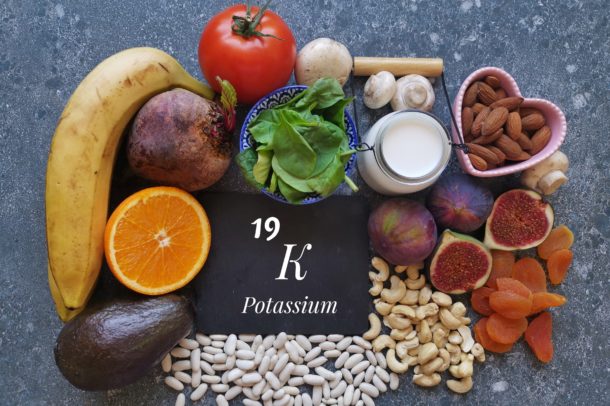
Reaching adequate potassium intake does not require supplementation, dramatic dietary restructuring, or tracking every gram of food you eat. The math is simple once you know which foods are actually delivering meaningful amounts. One banana provides approximately 420 mg. One baked potato with its skin gives you around 925 mg. One cup of cooked spinach contributes about 840 mg. One cup of cooked white beans delivers approximately 1,190 mg. For most adults sitting at the average intake of around 2,300 mg, adding a single one of those foods to an otherwise unchanged diet is enough to close the gap entirely and reach the adequate intake target.
For anyone eating a remotely Indian diet, this conversation becomes even more accessible. Rajma, chana, moong dal, palak, and aloo are all meaningfully high in potassium and are already staples in most households. The barrier here is not access or cost. It is simply awareness that these foods are doing something specific and measurable for cardiovascular health beyond just being generally nutritious. A bowl of rajma chawal is not just a protein source. It is one of the more potassium dense meals you can put together from a standard Indian kitchen. That framing matters because it connects an evidence based nutritional target to food that people are already eating or are already familiar with, which is almost always the most realistic path to actual dietary change.
It is also worth noting that potassium supplements are a different conversation. High dose potassium supplementation carries risks, particularly for people with kidney disease or those on certain medications like ACE inhibitors or potassium sparing diuretics, where potassium can accumulate to dangerous levels. The evidence being discussed here is about dietary potassium from whole foods, not supplemental doses. Food first is the right approach, and in this case, food is more than sufficient to close the gap for most healthy adults.
The Bottom Line
Cutting sodium is reasonable advice and the evidence supports it. But treating sodium reduction as the only meaningful dietary lever for blood pressure management means leaving a well evidenced, mechanistically understood, and practically accessible intervention completely untouched. The data from 22 randomized trials in hypertensive adults is clear enough to act on. Meaningful increases in potassium intake produce clinically relevant reductions in blood pressure through two independent biological pathways, and higher habitual intake is associated with substantially lower stroke risk at the population level. The intake gap is real, the foods that close it are already in most kitchens, and the only barrier is awareness. You do not need a supplement protocol or a complicated dietary overhaul. Add the dal. Keep the skin on the potato. Eat the spinach. The evidence has already done the work of justifying it.
References:
https://www.ncbi.nlm.nih.gov/books/NBK132099/
https://ods.od.nih.gov/factsheets/Potassium-Consumer/
https://www.who.int/tools/elena/interventions/potassium-cvd-adults