







When people talk about fat-soluble vitamins, the conversation almost always gravitates toward vitamin D. Occasionally vitamin A gets a mention. Vitamin E shows up in skincare discussions. But vitamin K sits quietly in the background, rarely discussed, poorly understood by most people including many health professionals, and significantly underresearched compared to its importance. That is starting to change. Over the past two decades, a growing body of evidence has revealed that vitamin K does far more than its original discovery suggested, and that many people are not getting enough of it in the forms that matter most.
What Vitamin K Actually Is
Vitamin K is not a single compound. It is a family of fat-soluble vitamins that share a common chemical structure but behave quite differently in the body depending on their form. The name itself comes from the German word Koagulationsvitamin, because Danish scientist Henrik Dam discovered it in 1929 while studying blood clotting. For decades that was essentially all vitamin K was known for. Today we understand it plays a central role in calcium regulation, bone metabolism, and vascular health through mechanisms that have nothing to do with blood clotting directly.
The two naturally occurring forms are vitamin K1, known as phylloquinone, and vitamin K2, known collectively as menaquinones. K1 is found in green leafy vegetables and makes up 75 to 90 percent of vitamin K intake in most Western diets. K2 exists in several subtypes, but the two most relevant for human health are MK-4, found in animal products like meat, eggs, and dairy, and MK-7, found primarily in fermented foods and most abundantly in natto, a Japanese fermented soybean product. There is also a synthetic form called K3 or menadione, but it is hepatotoxic and not used in human supplementation. Only the natural forms are relevant here.
How It Works in the Body
The core mechanism of vitamin K is straightforward once you understand it. Vitamin K acts as a coenzyme for an enzyme called gamma-glutamyl carboxylase, which activates certain proteins by enabling them to bind calcium ions. Without sufficient vitamin K, these proteins remain undercarboxylated and cannot do their jobs properly. Two of the most important proteins in this system are osteocalcin, which binds calcium into bone tissue and supports mineralization, and matrix Gla protein, which prevents calcium from depositing in arterial walls and soft tissues. Vitamin K essentially acts as a traffic director for calcium, helping ensure it goes to bones rather than blood vessels. This is why vitamin K deficiency or the use of medications that block vitamin K, such as warfarin, is associated with both weaker bones and increased arterial stiffness and calcification.
The distinction between K1 and K2 matters significantly here. K1 is primarily taken up by the liver and used quickly for blood clotting factors. MK-7 has a plasma half-life of approximately 72 hours compared to 1 to 2 hours for K1, which means it stays in circulation far longer and reaches extrahepatic tissues including bones and arterial walls at much higher concentrations. One study found that 25 micrograms of daily MK-7 may be more physiologically potent than 100 micrograms of K1 simply due to this difference in persistence. This pharmacokinetic difference is central to understanding which form is most relevant for bone and cardiovascular outcomes.
What the Evidence Shows
Bone health is where the evidence for vitamin K supplementation is most developed. Low vitamin K status is consistently associated with lower bone mineral density and higher fracture risk in observational data. At the mechanistic level, high levels of undercarboxylated osteocalcin, which indicate poor vitamin K status in bone tissue, correlate with lower bone density. A 2006 systematic review and meta-analysis covering 13 randomized controlled trials found that 12 of the 13 trials showed improved bone mineral density with vitamin K supplementation. The strongest evidence came from high-dose MK-4 at 45 milligrams per day, which is the dose approved as a pharmaceutical treatment for osteoporosis in Japan, and it significantly reduced rates of hip, vertebral, and non-vertebral fractures. For MK-7 at more practical supplemental doses, a well-designed three-year trial in 244 postmenopausal Dutch women found that 180 micrograms per day meaningfully decreased age-related bone density decline at the lumbar spine and femoral neck. A 2025 meta-analysis confirmed these findings, showing vitamin K supplementation enhances bone mineral density in middle-aged and older adults with more pronounced effects in women.
Cardiovascular health is where the story gets more nuanced. The observational data is compelling. The Rotterdam Study, which followed over 4,800 adults aged 55 and older, found that participants in the highest tertile of dietary menaquinone intake had 57 percent lower coronary heart disease mortality compared to those in the lowest tertile. Dietary K1 intake showed no such association. The biological rationale is strong because matrix Gla protein, when properly activated by vitamin K, actively inhibits arterial calcification. People with dp-ucMGP levels above 500 pmol/L, a marker of functional vitamin K insufficiency in vascular tissue, have a two to three times higher risk of cardiovascular disease events. However, the interventional trial data has been more mixed. Most randomized trials of MK-7 supplementation in general populations have not shown significant reductions in arterial stiffness or calcification. The more consistent signal has emerged in subgroup analyses involving people with pre-existing and extensive coronary artery calcification, where both K1 and K2 appear to slow progression. The current picture suggests vitamin K’s cardiovascular benefit may be most relevant for people who already have meaningful vascular calcification rather than as a primary prevention tool for healthy populations.
One genuinely interesting and more recent finding involves nocturnal leg cramps. A well-conducted randomized controlled trial published in JAMA Internal Medicine in 2024 found that 180 micrograms of MK-7 taken nightly for eight weeks in older adults reduced cramp frequency from approximately 2.6 per week to around 1 per week, reduced severity significantly, and cut duration from over one minute to under ten seconds. Improvements appeared within the first week. The proposed mechanism involves vitamin K’s effects on calcium channel activity in muscle cells, reducing excessive contractile activity. While this is a single trial, the effect size was large enough to be clinically meaningful for a population that has very few effective options for this common complaint.
The Intake Gap and Food Sources
Most people are not meeting even the basic adequate intake targets for vitamin K. In the US, the adequate intake is set at 120 micrograms per day for men and 90 micrograms per day for women. NHANES data shows average intake from food is around 122 to 138 micrograms per day, meaning many people are hovering right at or below the baseline threshold. Importantly, these targets were set primarily to prevent deficiency related bleeding complications and may underestimate the amount needed for optimal bone and vascular outcomes, given that the beneficial effects seen in trials typically used doses far above the adequate intake.
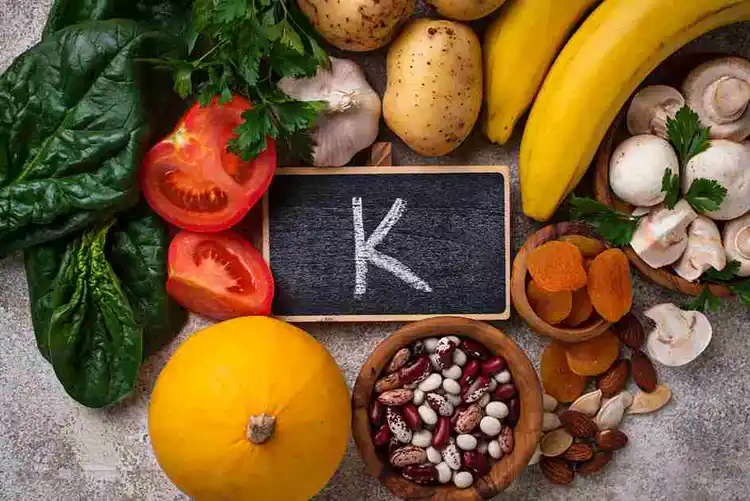
Food sources of K1 are not hard to find. Kale, spinach, broccoli, collard greens, and similar leafy vegetables are all high contributors. The practical caveat is that K1 from plant sources is tightly bound to chloroplasts and has poor bioavailability, with absorption from spinach as low as 5 to 10 percent. Adding fat to cooked vegetables meaningfully improves this, which is one reason cooking greens in a small amount of oil is genuinely beneficial and not just a culinary preference. K2 sources are more specific. Natto is by far the richest source with approximately 1,100 micrograms of MK-7 per 100 grams, but it is an acquired taste most people outside Japan are unfamiliar with. Fermented cheeses like Gouda, Brie, and camembert contain mixed menaquinones in meaningful amounts. Egg yolks, full-fat dairy, and chicken all provide MK-4 in smaller but still relevant quantities. Notably, reduced-fat dairy products contain only a fraction of the vitamin K found in full-fat versions, which is an underappreciated reason why the blanket advice to always choose low-fat dairy is more complicated than it sounds.
Supplementation: What to Know
If you are considering supplementation, the practical guidance from the current evidence is relatively clear. MK-7 at doses between 90 and 200 micrograms per day is the most well-supported option for general bone and vascular health given its superior bioavailability and extended half-life compared to K1 or MK-4 at physiological doses. It should be taken with food that contains some fat to ensure absorption. One important interaction worth knowing is that vitamin K directly counteracts warfarin and similar anticoagulant medications by restoring the clotting factor production those drugs are designed to suppress. Anyone on warfarin or vitamin K antagonists should consult their doctor before supplementing. MK-7 can interfere at doses as low as 10 micrograms due to its long half-life, making this interaction particularly relevant. Direct oral anticoagulants like rivaroxaban and dabigatran work through a different mechanism and are not affected by vitamin K intake.
The Bottom Line
Vitamin K is not a glamorous supplement, and it is not going to replace the fundamentals of training, nutrition, and recovery in any meaningful way. But for a fat-soluble vitamin with credible mechanistic and clinical evidence behind it for bone health, vascular calcification prevention, and emerging applications like leg cramps, it receives remarkably little attention relative to what the research actually supports. The practical starting point is simple. Eat your greens with fat. Include some fermented dairy or natto if it fits your diet. If you are older, postmenopausal, or have concerns about bone density or arterial calcification, a modest MK-7 supplement at 90 to 200 micrograms per day has a reasonable evidence base and an excellent safety profile. Vitamin K is not the most exciting topic in nutrition. But quietly and consistently, it is doing some of the most important work in your body every single day.
References:
https://pubmed.ncbi.nlm.nih.gov/34472618/
https://pubmed.ncbi.nlm.nih.gov/12540415/
https://pubmed.ncbi.nlm.nih.gov/9049691/
https://efsa.onlinelibrary.wiley.com/doi/epdf/10.2903/j.efsa.2009.1228
https://pubmed.ncbi.nlm.nih.gov/31119401/
https://pubmed.ncbi.nlm.nih.gov/15514282/
https://pubmed.ncbi.nlm.nih.gov/18722618/
https://pubmed.ncbi.nlm.nih.gov/32920644/
https://pubmed.ncbi.nlm.nih.gov/32616497/
https://pubmed.ncbi.nlm.nih.gov/39466236/
https://pubmed.ncbi.nlm.nih.gov/9918478/