




Most people treat sleep as the thing that happens after everything else is done. Training gets scheduled. Meals get planned. Supplements get tracked. And sleep gets whatever hours are left over after everything else has been accounted for. This is one of the most counterproductive habits in health and fitness, and the physiological cost of it is far larger than most people appreciate. Sleep is not passive downtime. It is when your brain clears toxic waste products, when short-term memories get consolidated into long-term storage, when testosterone is produced, when muscle protein synthesis peaks, and when the metabolic processes that determine body composition and performance are running at full capacity. When you shortchange sleep, you are not just feeling tired the next day. You are actively degrading the biological systems that every other health behaviour depends on. Understanding what damages sleep and what protects it is therefore not optional information. It is foundational.
What Is Actually Happening While You Sleep
Before getting into what hurts and helps sleep quality, it is worth understanding why it matters so much in the first place. During sleep, the brain activates a clearance system that removes metabolic waste products, including the toxic proteins associated with neurodegeneration, at a rate that is simply not possible during waking hours. During REM sleep specifically, the brain is actively consolidating memories, transferring information from short-term storage into long-term neural architecture. This is why sleep-deprived people struggle to retain new information regardless of how hard they study or practice.
Beyond the brain, insufficient sleep has been shown to increase systemic inflammation, impair focus and cognitive performance, undermine fat loss, disrupt insulin signalling, suppress testosterone production, and compromise cardiovascular health. After just one to two nights of poor sleep, ghrelin rises by around 24 percent, cortisol rises by 21 percent, leptin drops by 18 percent, muscle protein synthesis drops by 18 percent, and testosterone drops by 24 percent. These are not minor perturbations. They represent a fundamental shift in the hormonal environment toward one that drives fat storage, reduces anabolic capacity, increases stress load, and impairs recovery. And critically, most people cannot feel this happening. Subjective perception of performance remains largely intact even as the physiology deteriorates, which is exactly what makes chronic sleep compromise so dangerous for people who train.
On the other side of the equation, getting enough quality sleep improves mental performance, physical output, and emotional regulation in ways that no supplement or training optimisation can replicate. The ceiling on your results in the gym, in your body composition, and in your cognitive function is set in large part by how well you sleep. Everything else is built on top of that foundation.
What Damages Sleep Quality
Light
Light is the primary regulator of your biological clock, and it operates largely through melatonin, the hormone that signals to your body that it is time to sleep. Blue light, which is produced by the sun but also by the screens of phones, computers, and televisions, disrupts melatonin production in ways that meaningfully delay sleep onset and reduce sleep quality. Even the relatively small screen of a smartphone produces enough blue light to reduce subjective sleepiness before bed, even in cases where serum melatonin levels are not dramatically affected. The implication is that the effect of screens on sleep readiness is not purely hormonal. There is a stimulation and alertness component that operates through other pathways as well.
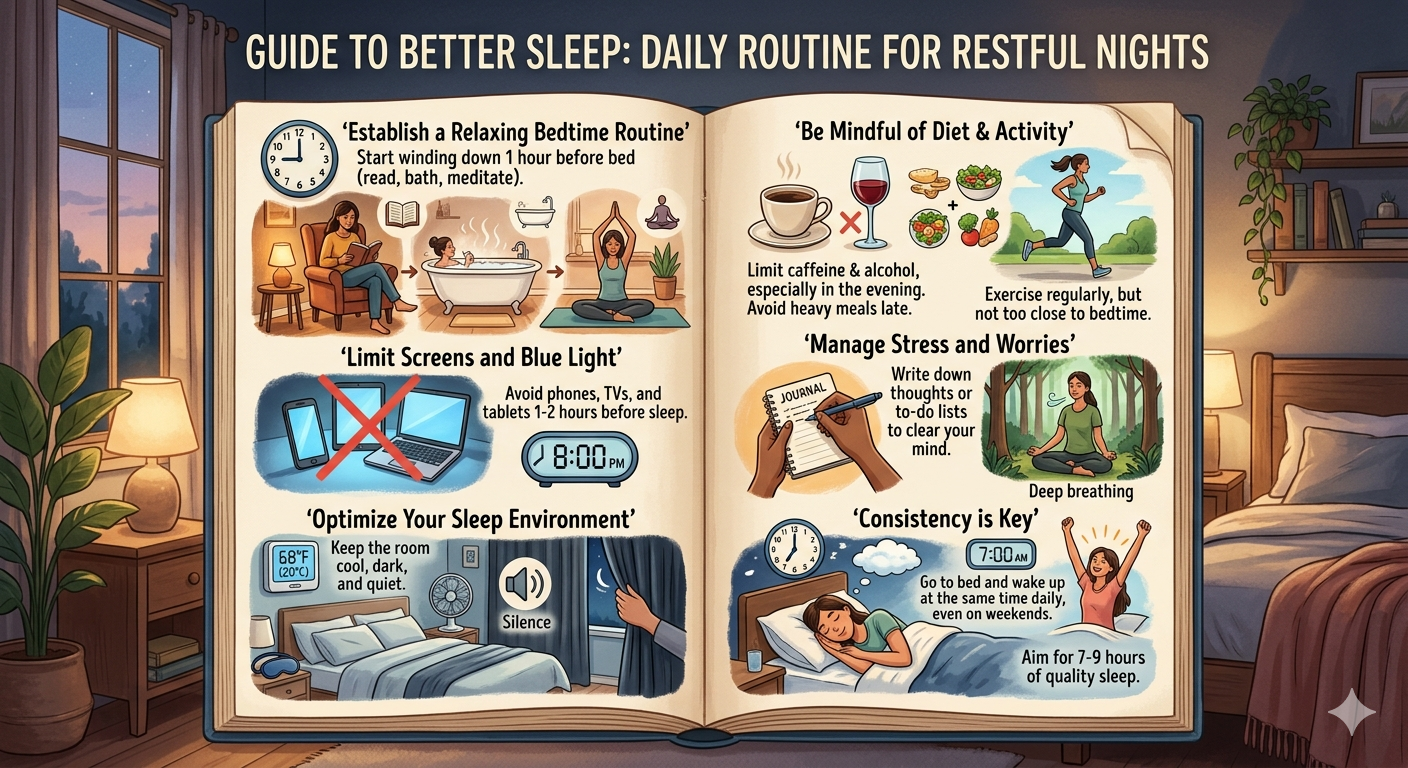
The practical guidance here is to avoid bright and blue light sources in the two hours before bed. If avoiding screens entirely is not realistic, reducing blue light output through built-in night mode settings on most modern devices is a meaningful partial solution. Blue-light-blocking glasses worn in the evening have also been shown to help advance sleep timing in people with delayed sleep phase patterns. And the light management does not stop at falling asleep. Even when you are already asleep, ambient light in the bedroom continues to impair sleep quality and the depth of sleep stages reached. Blackout curtains or a sleep mask are not excessive measures. They are logical extensions of the same principle that brought you to reduce pre-sleep screen exposure in the first place.
Noise
Sound is a less commonly discussed sleep disruptor but operates through mechanisms that are just as physiologically real as light. Sounds that do not wake you up can still impair sleep quality and increase stress responses during the night. The type of noise matters considerably. Sudden noises are far more disruptive than constant background sounds, which is why a consistently running fan or air conditioner typically disturbs sleep less than intermittent traffic or voices, even if the absolute volume of the latter is lower. Meaningfully, noises that carry semantic content, like speech or a baby crying, are disproportionately disruptive relative to their volume because the brain continues processing meaningful sound even during sleep. If you cannot control your sleep environment noise, earplugs reduce high-frequency sounds most effectively, which covers the sudden sharp noises that are most likely to fragment sleep.
Heat
Core body temperature dropping is one of the physiological signals that initiates sleep onset. Elevated ambient temperature that prevents or reverses this drop makes falling asleep harder and reduces the depth of sleep stages reached throughout the night. Research has shown that heat can impair sleep quality more significantly than noise, which places bedroom temperature management higher on the priority list than most people place it. A cool sleeping environment, one comfortable enough not to cause discomfort from cold but sufficiently cool to facilitate core temperature reduction, speeds up sleep onset and supports entry into deeper sleep stages. This is not a marginal effect. It is a meaningful lever that costs nothing to adjust.
Alcohol
Alcohol is one of the most widespread and culturally normalised sleep disruptors, and it is commonly misunderstood because it does genuinely help with relaxation and initial sleep onset. The problem is that this initial sedating effect fades with repeated use and comes at a significant cost to sleep architecture. Alcohol impairs sleep quality from the very first night of use close to bedtime, disrupting REM sleep and the restorative processes that depend on it. With continued use near bedtime, even the initial sedating effect diminishes, leaving only the sleep quality impairment. Alcohol-use disorders are independently associated with insomnia, and while the causal direction is complex, the sleep-disrupting effects of alcohol are well established regardless of consumption level. Avoiding alcohol after dinner is the practical guideline that most consistently protects sleep quality in people who drink.
Caffeine
Caffeine is perhaps the most important sleep-related variable for anyone who trains, because it is universally consumed and its effects on sleep are significantly underappreciated. Caffeine works primarily by blocking adenosine receptors in the brain. The A1 receptor, which promotes sleepiness when activated, does not appear to develop significant tolerance to caffeine’s blocking effect, which is why caffeine retains its alertness-promoting effect even in habitual users. This same persistence is what makes caffeine so damaging to sleep when consumed too late in the day. Even in people who can fall asleep normally with caffeine in their system, the caffeine continues making the sleeping brain more alert and the sleep more shallow throughout the night. The research suggests that caffeine consumed within six hours of bedtime measurably impairs sleep quality, and many habitual users who report no subjective effect are still experiencing objective sleep quality degradation without realising it. An afternoon pre-workout or a post-dinner coffee is not a neutral choice if you care about recovery.
What Protects and Improves Sleep Quality
Exercise
The relationship between exercise and sleep is bidirectional and mutually reinforcing. Regular physical activity during the day is one of the most consistently supported lifestyle behaviours for improving sleep quality, and this effect has been demonstrated across multiple modalities including aerobic exercise, resistance training, and meditative movement practices like yoga and tai chi. The mechanism is not entirely understood, but physical activity appears to support circadian entrainment, reduce anxiety, and improve the depth and efficiency of sleep architecture in ways that extend to both subjective sleep satisfaction and objective sleep stage measures.
The more commonly debated question is whether exercising at night is problematic. The honest answer is that it is more nuanced than the conventional advice suggests. Exercise does raise core body temperature, which we have established is not conducive to sleep onset, and it does increase epinephrine output, both of which would theoretically disrupt sleep if training happens immediately before bed. In practice, high-intensity evening exercise has been shown to disrupt REM sleep in some research while leaving other objective sleep quality measures intact in healthy people without sleep disorders. The more significant concern is the potential to shift circadian rhythm, since the body associates physical activity with daytime, and regular late-night training can gradually delay sleep timing. Individual variability here is real and meaningful. If you notice that training close to bedtime genuinely disrupts your ability to fall asleep or leaves you feeling unrested, shifting your training window earlier is a legitimate and evidence-supported adjustment. But exercising at any time, including at night, is better for sleep quality than not exercising at all.
A Consistent Sleep Schedule
Your circadian rhythm is a 24-hour biological clock that governs nearly every physiological process in the body, and sleep quality is directly tied to how well that rhythm is maintained and how consistently it is reinforced. An irregular sleeping schedule that varies significantly from night to night throws the circadian rhythm into disarray in ways that impair both sleep onset time and sleep quality, even when total sleep hours appear adequate. Going to bed at approximately the same time every night is one of the highest-leverage, zero-cost interventions available for sleep quality, and it is consistently underemphasised relative to sleep hygiene advice about specific products or substances.
A consistent bedtime routine amplifies this effect by providing the body with reliable pre-sleep cues that signal the transition toward sleep. The content of that routine matters less than its consistency. Showering, reading, light stretching, or a few minutes of quiet meditation all serve the same circadian signalling function as long as they are performed in the same order and at the same time regularly. What the routine should not include are activities that strongly stimulate alertness or sensory engagement, screen-based activities that involve high cognitive engagement or emotional arousal, or bright light exposure. The goal of a bedtime routine is to gradually reduce nervous system activation in the hour or two before sleep, reinforcing the biological transition from wakefulness to rest that the circadian clock is already trying to make.
The Bottom Line
Sleep is the variable that either enables or undermines everything else you do for your health. Training adaptation, fat loss, hormonal health, cognitive function, immune regulation, and emotional stability all depend on the quality of sleep you are building on top of. The factors that damage sleep quality, principally light exposure too close to bed, noise disruption, a warm sleeping environment, alcohol near bedtime, and caffeine consumed in the six hours before sleep, are all modifiable with relatively low effort once you understand why they matter. The factors that protect and improve sleep quality, consistent exercise spread across the day and an unwavering sleep schedule reinforced by a consistent pre-sleep routine, are similarly accessible. None of this requires a supplement, a wearable, or an expensive intervention. It requires understanding the physiology and making decisions that are aligned with it rather than working against it. Sleep is not what happens when you have nothing left to do. It is where the results of everything you did during the day are either built or broken down.
Reference:
https://pubmed.ncbi.nlm.nih.gov/26900325/
https://pubmed.ncbi.nlm.nih.gov/28140399/
https://pubmed.ncbi.nlm.nih.gov/28345624/
https://pubmed.ncbi.nlm.nih.gov/27969011/
https://pubmed.ncbi.nlm.nih.gov/25774609/
https://pubmed.ncbi.nlm.nih.gov/10505822/
https://pubmed.ncbi.nlm.nih.gov/16492658/
https://pubmed.ncbi.nlm.nih.gov/21489866/
https://pubmed.ncbi.nlm.nih.gov/25729341/
https://pubmed.ncbi.nlm.nih.gov/24667276/
https://pubmed.ncbi.nlm.nih.gov/28367676/
https://pubmed.ncbi.nlm.nih.gov/23691095/