






Introduction
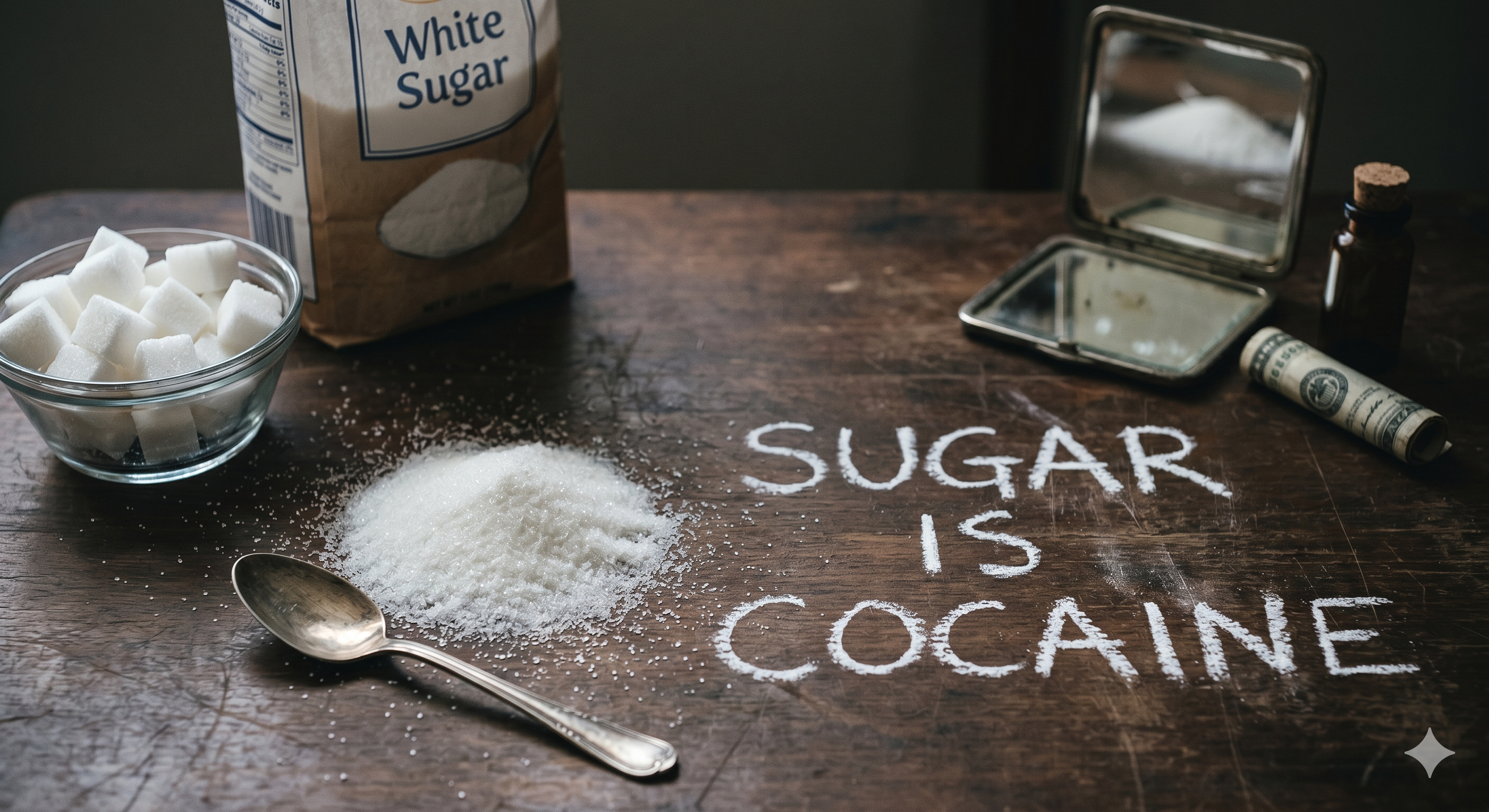
Sugar is evil. Sugar is addictive. Sugar is basically cocaine. You have heard all of it from wellness influencers, documentary makers, and health headlines. And at first glance it feels true because you genuinely cannot stop eating certain foods and sugar seems like the obvious culprit. But what if the whole story is wrong? Let us go through this properly, with no fear mongering and no agenda.
Where the Sugar Addiction Argument Came From
The idea that sugar is addictive became popular largely because of rodent studies. Researchers gave rats unlimited access to sugar and observed what looked like addictive behavior – compulsive consumption, withdrawal symptoms, and escalating intake over time. The headlines ran with it. Sugar is as addictive as cocaine. Sugar lights up the same reward pathways as drugs.
Here is the problem. Rats are not humans. Rats do not eat birthday cake at a party. They do not reach for chips while watching television. They do not eat emotionally after a stressful day. When researchers actually studied food addiction in humans using validated questionnaires across over 1,400 people, something very revealing emerged. And it did not point to sugar.
What the Human Research Actually Found
A large study asked participants to identify which foods they struggled most to control their intake of. The results were clear. The foods people genuinely struggled with were not sugary foods on their own. They were high fat savoury foods like chips, fries, and cheese and high fat sweet foods like cake, chocolate, and ice cream. Plain sugary foods like candy, juice, and dried fruit were actually among the lowest on the entire list.
Nearly 30 percent of food addiction symptoms were attributed to high fat savoury foods. Around 25 percent to high fat sweet foods. Plain sugary foods were far behind both. So when people say they are addicted to sugar, what they are almost always actually describing is an inability to stop eating foods that combine fat and sugar together, or fat with salt and starch. Not sugar by itself.
The Simple Test Nobody Thinks About
When did you last sit down and eat sugar cubes one after another, unable to stop? When did you last binge on plain hard candy until you felt out of control? You probably have not. Because plain sugar on its own is actually not that compelling. Now compare that to potato chips, a warm chocolate chip cookie, or a creamy pasta dish. These are the foods people genuinely struggle to moderate.
What do they all have in common? They are combinations. Fat plus starch. Fat plus sugar. Fat plus salt plus crunch. Food scientists actually work to find what they call the bliss point the precise combination of fat, sugar, salt, and texture that makes a food as rewarding as possible. These foods are engineered to override your normal fullness signals. The problem was never sugar alone. The problem is hyperpalatable food.
But What About the Cocaine Comparison?
This one gained massive traction because of a study showing that rats preferred sweet water over cocaine. The headlines turned this into “sugar is more addictive than cocaine.” Here is what those headlines left out. The rats preferred sweetness only when cocaine had a delayed delivery. When researchers removed the time delay, cocaine preference went up significantly. The rats were choosing what arrived faster, not what was more rewarding.
Cocaine causes genuine physical dependence, withdrawal symptoms, and long term neurological changes. Sugar does not meet the clinical criteria for addiction in humans. No serious addiction researcher classifies it that way. And here is perhaps the clearest argument of all nobody struggles to stop eating fruit. Fruit is loaded with sugar. If sugar were genuinely addictive the way cocaine is, fruit would be a public health crisis. It is not. Nobody is bingeing on oranges.
So Why Do You Feel Out of Control Around Certain Foods?
Your brain is wired to seek out calorie dense, rewarding foods. This is ancient biology. For most of human history, calorie dense foods were rare and finding them was survival. The problem today is that your biology has not changed but your food environment has completely transformed. You now live in a world where the most expertly engineered foods in human history are available everywhere, at low cost, in enormous portions, at any hour of the day.
This is not a character flaw. It is not weak willpower. It is biology meeting a food environment that is specifically designed to override your natural satiety signals. Your brain is running ancient software in a completely modern environment, and the modern food industry was built to exploit exactly that.
What This Means for Your Diet in Practice
If your goal is fat loss, the foods most likely to sabotage your calorie deficit are not the ones with the most sugar. They are the ones that combine the most fat with the most reward. If you know certain foods reliably lead to overeating, removing them from your immediate environment is not restriction, it is just smart. You are not testing your willpower every time you open the cupboard. You are removing the need for willpower entirely.
If you are someone whose eating feels genuinely out of control, particularly if it is tied to low mood, stress, or emotional distress, that is worth exploring with a professional. The food is rarely the root cause. It is usually the coping mechanism.
The Bottom Line
Sugar is not poison. It is not cocaine. It is not the single cause of the obesity epidemic and it is not uniquely addictive in the way that drugs are. What the evidence actually shows is that the foods most associated with overeating are those that combine fat with sugar, or fat with salt and starch, in ways that light up the brain’s reward system more powerfully than any single ingredient ever could.
Understanding that is not depressing. It is actually liberating. Because it means the solution is not hating yourself for lacking willpower around food that was literally designed to override your self control. Stop fearing sugar. Start understanding what actually drives you to overeat. That is where the real work begins.
References:
https://pmc.ncbi.nlm.nih.gov/articles/PMC7853096/
https://pubmed.ncbi.nlm.nih.gov/40043691/