





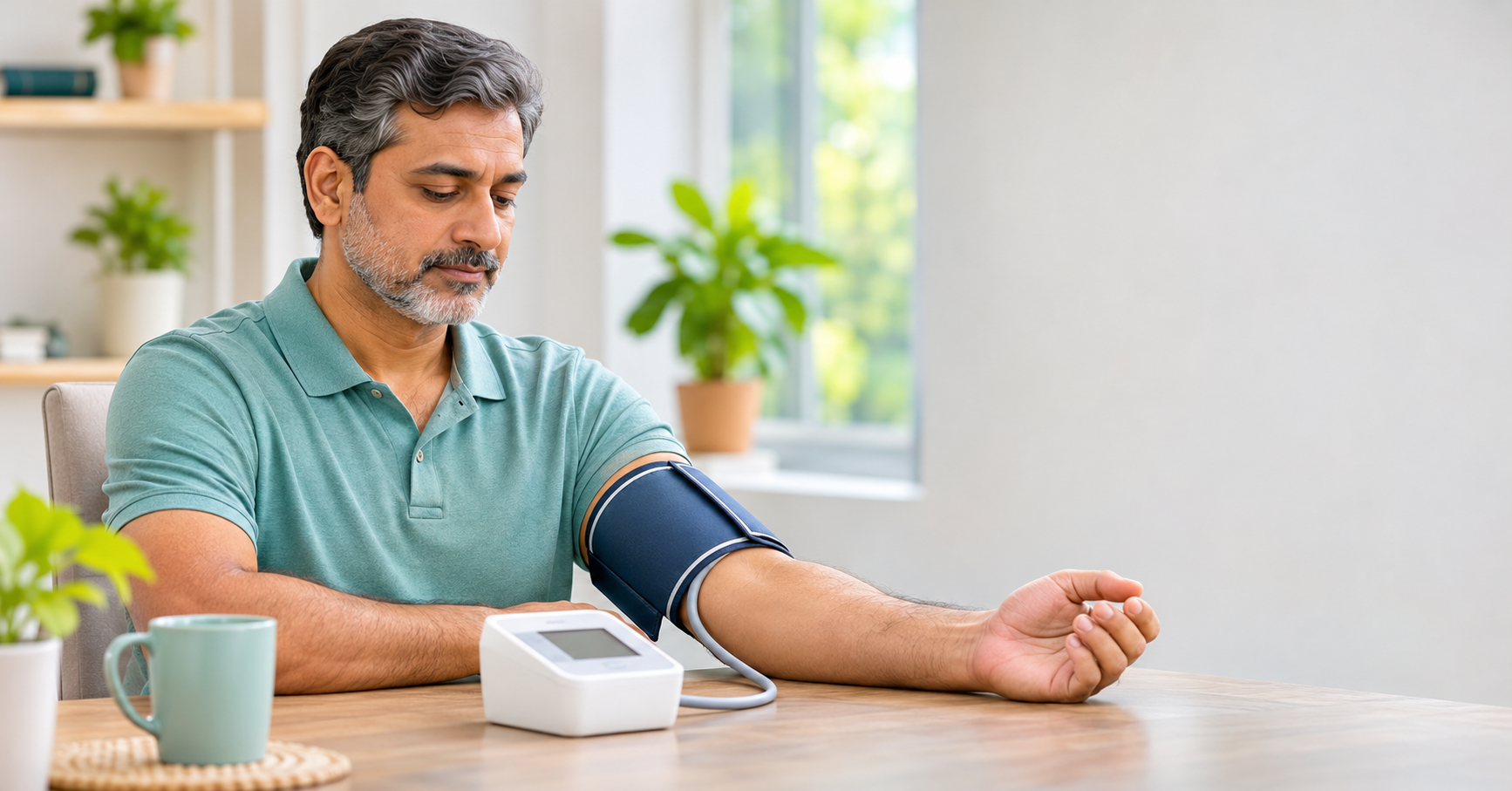
A normal blood pressure for an adult is below 120/80 mmHg. Hypertension in India is defined as 140/90 mmHg or higher, confirmed on two separate clinic visits. The number that surprises most people is this: the target does not rise with age. A 65-year-old and a 30-year-old are measured against the same thresholds.
This guide explains the categories used in India, what each number means, why “normal for my age” is a myth, how to measure blood pressure properly, and when a reading needs medical attention.
What the Two Numbers Mean
- Systolic (the upper number) is the pressure in your arteries when the heart contracts and pushes blood out.
- Diastolic (the lower number) is the pressure between beats, when the heart refills.
Both matter. If your systolic and diastolic readings fall into different categories, the higher category is the one that applies.
Blood Pressure Categories Used in India
The Indian Council of Medical Research’s standard treatment workflow for hypertension in adults uses these categories:
| Category | Systolic (mmHg) | Diastolic (mmHg) |
|---|---|---|
| Normal | Below 120 | Below 80 |
| Elevated BP | 120–139 | 80–89 |
| Grade 1 hypertension | 140–159 | 90–99 |
| Grade 2 hypertension | 160–179 | 100–109 |
| Grade 3 hypertension | 180 or above | 110 or above |
Diagnosis requires confirmation. A single high reading is not a diagnosis. Hypertension is diagnosed when 140/90 mmHg or higher is confirmed across two different clinic visits. The exception is a single reading of 160/100 mmHg or above, which is sufficient on its own.
Note that some international guidance, including the 2017 American College of Cardiology and American Heart Association guideline, uses lower thresholds and labels 130–139/80–89 mmHg as stage 1 hypertension. Indian clinical practice generally follows the 140/90 definition above. Your doctor will interpret your reading against the standard they use.
Why There Is No Separate “Normal by Age”
Charts circulating online often list a higher “normal” for each decade of life. Average blood pressure does rise with age in most populations, because arteries stiffen over time. But average is not the same as healthy. Clinical targets do not loosen as you get older, because the cardiovascular risk from a given pressure does not loosen either.
What does change with age is the treatment target your doctor may set:
| Situation | Usual control target |
|---|---|
| All adults | Below 140/90 mmHg |
| Diabetes, chronic kidney disease, or established cardiovascular disease | Below 130/80 mmHg, if tolerated |
| Age 80 and above | Below 150/90 mmHg |
These are targets for people already being treated, decided by a doctor. They are not a redefinition of normal.
How Common Is High Blood Pressure in India?
The ICMR-INDIAB study, published in The Lancet Diabetes & Endocrinology in 2023, assessed over 1.1 lakh adults across 31 states and union territories. It found hypertension in 35.5% of adults – roughly one in three.
The bigger problem is detection. A 2022 systematic review in The Lancet Regional Health – Southeast Asia, pooling Indian population studies, found that 53% of people with hypertension were unaware of it. High blood pressure usually produces no symptoms at all until it has already caused damage, which is why it is often called a silent condition.
Symptoms: Why You Cannot Feel It
Most people with high blood pressure feel completely well. When symptoms do appear, they are non-specific and usually indicate that pressure is already very high:
- Headaches, particularly early morning
- Breathlessness on mild exertion
- Nosebleeds
- Dizziness or visual disturbance
- Chest discomfort
- Palpitations
Waiting for symptoms is not a strategy. The only reliable way to know your blood pressure is to measure it.
What Uncontrolled High Blood Pressure Damages
Pressure that stays high over years places constant strain on blood vessels and the organs they supply:
- Heart: thickening of the heart muscle, heart failure, heart attack
- Brain: stroke, and vascular contributions to cognitive decline
- Kidneys: gradual loss of filtering capacity, eventually chronic kidney disease
- Eyes: damage to the small vessels of the retina
- Arteries: accelerated hardening and narrowing throughout the body
How to Measure Blood Pressure Correctly
A badly taken reading is worse than no reading, because it leads to the wrong conclusion. For an accurate measurement:
- Sit quietly for five minutes first. Rushing in and measuring immediately inflates the reading.
- Sit with your back supported and feet flat on the floor. Crossed legs raise the reading.
- Rest your arm on a table at heart level. An unsupported or low arm gives a falsely high value.
- Use the correct cuff size. A cuff too small for the arm overestimates pressure.
- Place the cuff on bare skin, not over a sleeve.
- Don’t talk during the measurement.
- Avoid caffeine, tobacco and exercise for 30 minutes beforehand, and empty your bladder first.
- Take two or three readings a minute apart and record the average, not the lowest.
White Coat and Masked Hypertension
Two patterns complicate single clinic readings:
- White coat hypertension: readings are high in a clinic but normal at home, driven by the stress of the setting.
- Masked hypertension: readings are normal in a clinic but high in daily life. This is the more dangerous of the two, because it goes undetected.
Where there is doubt, a doctor may ask for home readings over several days or arrange 24-hour ambulatory monitoring.
Which Tests Accompany a Blood Pressure Check
High blood pressure is rarely assessed alone. A doctor typically also looks at:
- Kidney function: creatinine with eGFR, and urine albumin-to-creatinine ratio
- Blood sugar: fasting glucose and HbA1c, since diabetes and hypertension often travel together
- Lipid profile: to assess overall cardiovascular risk
- Electrolytes: sodium and potassium
- ECG: to look for strain on the heart muscle
- Thyroid function, where symptoms suggest it
For adults aged 65 and above, ICMR also advises checking blood pressure while standing, to detect a drop on standing that raises the risk of falls.
What Lowers Blood Pressure
Lifestyle measures are the foundation, with or without medication:
- Reduce salt. Most of the excess comes from processed and restaurant food, pickles, papad, namkeen and packaged snacks, not from the salt added at the table.
- Lose excess weight, particularly around the waist.
- Move regularly: most guidance suggests around 150 minutes a week of moderate activity.
- Limit alcohol, and stop tobacco in every form.
- Eat more potassium-rich food such as fruit, vegetables and pulses, unless your doctor has restricted potassium for kidney reasons.
- Sleep adequately and address untreated snoring or sleep apnoea.
- Take prescribed medication consistently. Blood pressure medicine works while it is being taken; stopping because the reading improved is the most common reason control is lost.
When to Seek Medical Attention Immediately
A reading of 180/120 mmHg or above, especially with chest pain, breathlessness, severe headache, weakness on one side, difficulty speaking or visual loss, is a medical emergency. Do not wait for a routine appointment.
Frequently Asked Questions
1. What is a normal blood pressure by age?
Normal is below 120/80 mmHg for adults at any age. There is no separate normal range for each decade. Average blood pressure does rise with age because arteries stiffen, but clinical targets do not loosen, since the risk attached to a given pressure does not reduce with age.
2. What blood pressure is considered high in India?
Hypertension is defined as 140/90 mmHg or higher, confirmed on two separate clinic visits. A single reading of 160/100 mmHg or above is enough to diagnose it. Readings of 120–139/80–89 mmHg are classed as elevated blood pressure, which needs attention but is not yet hypertension.
3. Is 130/90 high blood pressure?
Under the thresholds generally used in India, a systolic of 130 falls in the elevated range, but a diastolic of 90 reaches Grade 1 hypertension. When the two numbers fall in different categories, the higher one applies, so this reading needs a repeat measurement and a doctor’s review.
4. Why is high blood pressure called a silent condition?
Because it usually causes no symptoms until it has already damaged the heart, kidneys, brain or eyes. A 2022 review of Indian population studies found 53% of people with hypertension were unaware of it. Measurement is the only reliable way to detect it.
5. How often should I check my blood pressure?
Adults should have blood pressure measured at every clinic visit, and at least once a year as part of a routine checkup. People with elevated readings, diabetes, kidney disease or a family history need more frequent checks, as advised by their doctor.
6. What is the correct way to measure blood pressure at home?
Sit quietly for five minutes, back supported and feet flat, with your arm resting at heart level. Use the right cuff size on bare skin, stay silent during the reading, and avoid caffeine, tobacco and exercise for 30 minutes beforehand. Take two or three readings a minute apart and record the average.
7. Can one high reading mean I have hypertension?
Usually not. A single elevated reading can be caused by stress, caffeine, a full bladder, poor posture or an incorrectly sized cuff. Diagnosis requires confirmation across two separate visits, except when a reading reaches 160/100 mmHg or higher.
8. Which blood tests are done along with a blood pressure check?
Commonly kidney function tests with creatinine and eGFR, urine albumin-to-creatinine ratio, fasting glucose and HbA1c, a lipid profile, sodium and potassium, and an ECG. These assess both the causes and the consequences of raised blood pressure.
9. Does blood pressure medication have to be taken for life?
Often, but not always. Some people with mild hypertension and significant weight loss or lifestyle change can reduce or stop medication under medical supervision. Stopping on your own because the reading improved is the most common reason control is lost. Any change should be a doctor’s decision.
10. What blood pressure reading is a medical emergency?
A reading of 180/120 mmHg or above requires urgent attention, especially with chest pain, breathlessness, severe headache, one-sided weakness, difficulty speaking or sudden visual loss. Seek emergency care rather than waiting for a scheduled appointment.
11. Can young adults get high blood pressure?
Yes. Hypertension is no longer confined to older age groups, and sedentary work, excess weight, high salt intake, stress and poor sleep all contribute in younger adults. Anyone over 18 should have blood pressure measured at routine health visits.
12. Where can I get blood pressure and related tests done in Pune?
Blood pressure is measured at any clinic visit, and the blood tests that accompany it – kidney function, HbA1c, lipid profile, electrolytes – are available at diagnostic centres across Pune, including Fittr Labs in Kharadi, which offers home sample collection for the blood tests. An ECG requires a centre visit.