


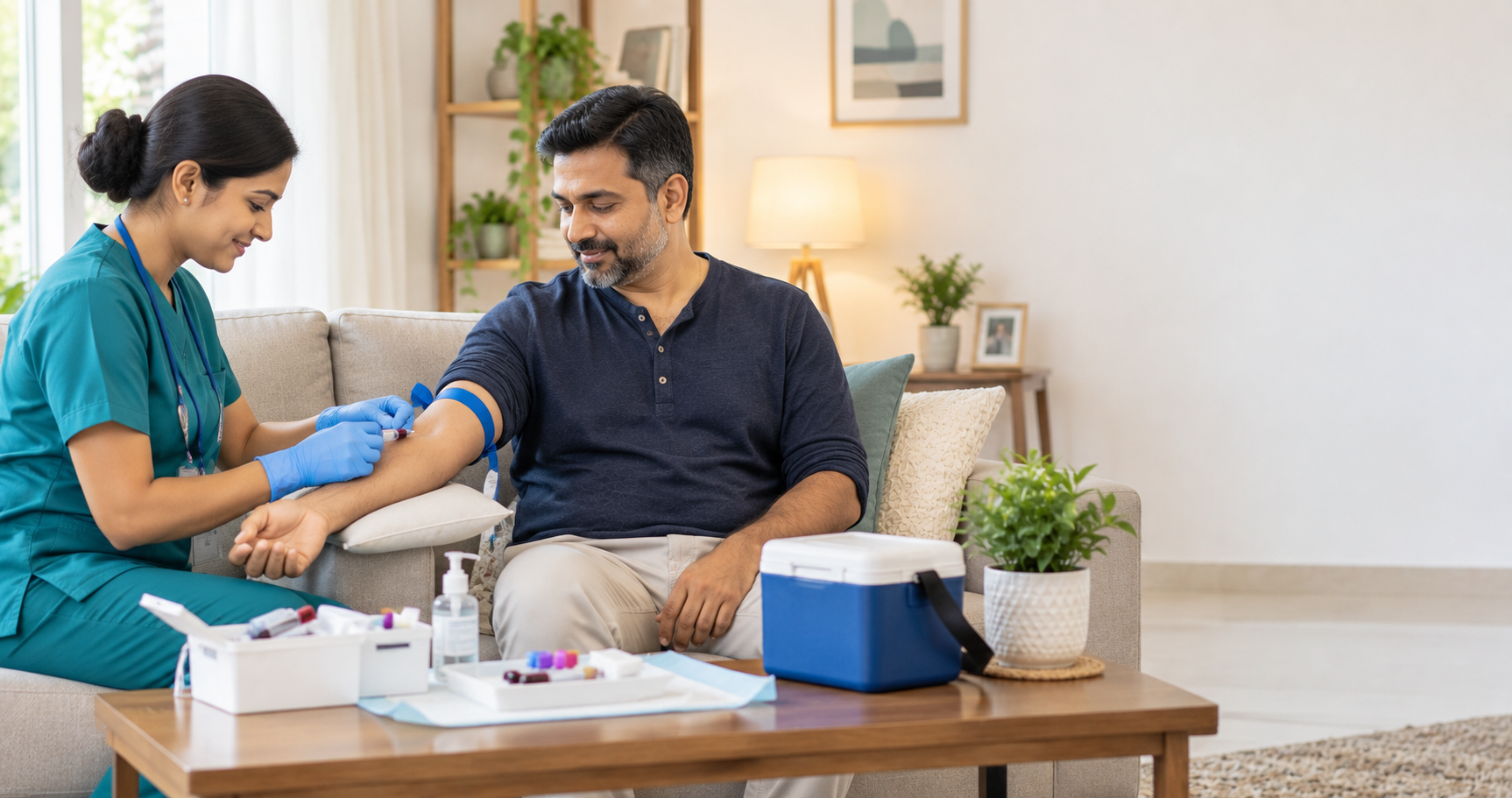
A home blood test means a trained phlebotomist visits your home, collects your blood or urine sample, and transports it to a diagnostic lab for testing. You get the same lab analysis as a walk-in visit, without travelling, waiting in a queue or rushing out on an empty stomach.
This guide explains how at-home sample collection works step by step, which tests can and can’t be done at home, how accuracy is maintained, and how to prepare for a smooth collection.
How At-Home Sample Collection Works?
Step 1: Booking the Test
You choose your test or health package and pick a collection time slot. For fasting tests, an early-morning slot is usually the most practical.
Step 2: Preparation
You receive preparation instructions based on your tests, such as fasting for 8–12 hours for blood sugar and lipids, or collecting a first-morning urine sample.
Step 3: The Phlebotomist’s Visit
A trained phlebotomist arrives with a sealed collection kit. They confirm your details, choose the correct tubes for your tests, and draw the sample from a vein in your arm. The draw itself usually takes just a few minutes.
Step 4: Labelling and Storage
Each tube is labelled with your details in front of you. It’s then placed in a temperature-controlled carrier to protect the sample during transport.
Step 5: Transport to the Lab
Samples are carried to the diagnostic lab within set time limits. This step matters because some blood components change if a sample is left too long or exposed to heat.
Step 6: Testing and Digital Report
The lab analyses the sample using the same equipment and quality processes as for walk-in samples. Your report is shared digitally once results are verified.
Which Tests Can Be Done at Home?
Most routine blood and urine tests can be collected at home, including:
- Blood sugar: fasting glucose, post-meal glucose, HbA1c
- Lipid profile
- Thyroid profile: TSH, T3, T4
- Complete blood count (CBC)
- Liver function and kidney function tests
- Vitamin D, Vitamin B12, iron studies and ferritin
- Hormone tests, such as testosterone or cortisol, where timing instructions are followed
- Urine routine and urine culture
- Preventive health and full-body checkup packages
Which Tests Need a Centre Visit?
Some tests need equipment or supervision that isn’t practical at home:
- Imaging: X-ray, ultrasound, DEXA scans
- Heart and lung function tests that need specialised equipment, such as a treadmill test or spirometry
- Tests with multiple timed samples, such as a glucose tolerance test, which requires staying for about two hours between draws
- Fitness assessments, such as VO2 max testing
If your package includes any of these, blood collection may still be done at home, with a separate centre visit for the rest.
Are Home-Collected Samples as Accurate?
Yes, when collection and transport follow proper protocols. The testing itself happens in the same lab either way. What matters is what happens before the sample reaches the analyser.
Most errors in lab testing don’t happen during analysis. A 2025 study in Clinical Chemistry and Laboratory Medicine reviewed about 11 million specimens and found that 98.4% of errors occurred in the pre-analytical phase: collection, handling and transport. Common problems include:
- Haemolysis: red blood cells breaking down because of a difficult draw, rough handling or heat
- Clotted samples in tubes that should stay liquid
- Wrong tube or incorrect filling
- Labelling mistakes
- Delays between collection and testing
These risks apply to lab visits too. A good home collection service reduces them with trained phlebotomists, correct tubes, labelling in front of the patient, temperature-controlled carriers and fixed transport timelines.
What to Check When the Phlebotomist Arrives
- The needle and collection kit come from a sealed, single-use pack opened in front of you.
- The phlebotomist wears fresh gloves and cleans the site with an alcohol swab.
- Tubes are labelled with your name before or right after the draw, in front of you.
- Samples go into a cooler or temperature-controlled box, not a loose bag.
- Used needles go straight into a sharps container.
How to Prepare for a Home Blood Test
- Fasting: follow the instructions exactly; plain water is allowed and helps.
- Hydration: drink water beforehand, as it makes veins easier to find.
- Clothing: wear a loose, short-sleeved top or one with easy-to-roll sleeves.
- Space: keep a chair with an armrest or a table ready, in good light.
- Medicines: take regular medicines unless your doctor advises otherwise, and tell the phlebotomist what you take.
- Exercise: avoid intense workouts the day before, as they can temporarily affect some markers.
- After the draw: press gently on the site for a few minutes and avoid lifting heavy weights with that arm for a few hours.
Who Benefits Most From Home Collection?
- Busy professionals who can’t fit a lab visit into a workday
- Elderly people and anyone with limited mobility
- People with chronic conditions who need frequent monitoring, such as diabetes or thyroid disorders
- Families who want several members tested in one visit
- Fasting patients who would rather not travel on an empty stomach
- People recovering from illness or injury
When a Lab Visit Is the Better Choice
A centre visit may suit you better if:
- Your tests include imaging, heart function tests or timed samples.
- You have very difficult veins and previous draws needed multiple attempts.
- You want same-visit consultations with specialists alongside your tests.
Frequently Asked Questions
1. Where can I book a blood test with home sample collection in Pune?
You can book a blood test with home sample collection from Fittr Labs in Pune. A trained phlebotomist collects your sample at home and it is tested at the Fittr Labs diagnostic centre in Kharadi. Tests that need equipment, such as imaging, can be done at the centre.
2. How does a home blood test work?
You book a test and time slot, follow any fasting instructions, and a trained phlebotomist visits your home to collect the sample. The sample is labelled, stored in a temperature-controlled carrier, and taken to the lab for testing. You then receive a digital report.
3. Are home blood test results as accurate as a lab visit?
Yes, when proper collection and transport protocols are followed. Home samples are tested in the same lab with the same equipment. Accuracy depends on correct tubes, careful handling, temperature control and timely transport, which matter equally for walk-in samples.
4. Which blood tests can be done at home?
Most routine tests can be collected at home. These include blood sugar, HbA1c, lipid profile, thyroid profile, CBC, liver and kidney function tests, Vitamin D, Vitamin B12, iron studies, many hormone tests, urine tests, and full-body checkup packages.
5. Which tests cannot be done at home?
Imaging tests like X-ray, ultrasound and DEXA scans need a centre visit. So do tests that require specialised equipment, such as treadmill tests or spirometry, and tests that need several timed samples, such as a glucose tolerance test.
6. Can I do a fasting blood test at home?
Yes. Book an early-morning slot, fast for 8–12 hours overnight as instructed, and drink plain water. Home collection is especially convenient for fasting tests, since you don’t have to travel on an empty stomach.
7. How long does a home blood sample collection take?
The blood draw usually takes about 5–10 minutes, including verifying your details, drawing the sample and labelling the tubes. You can go about your day immediately afterwards.
8. How should I prepare for a home blood test?
Follow the fasting instructions, drink water, and wear a loose short-sleeved top. Keep a chair and table ready in a well-lit spot, and tell the phlebotomist about any medicines or supplements you take. Avoid intense exercise and alcohol the day before.
9. Is home blood sample collection suitable for elderly parents?
Yes. Home collection is especially helpful for elderly people and anyone with limited mobility, as it avoids travel, waiting and fatigue. It also makes regular monitoring of conditions like diabetes, thyroid disorders or kidney function much easier to keep up.
10. Can I book a full-body checkup at home in Pune?
Yes. Fittr Labs offers home sample collection in Pune for full-body checkups and individual blood tests. Blood and urine samples are collected at home and tested at the lab. Any imaging tests in a package are done at the Fittr Labs centre in Kharadi.
Skip the queue and the commute. Book a blood test with home sample collection from Fittr Labs, Pune. [Book a Lab Test]